Register company in Poland – which legal form of business activity should you choose?
12 March 2026
12 March 2026

Choosing the right legal form is one of the most important decisions when you register a company in Poland. The structure you choose affects not only how the business is managed, but also the scope of liability, taxation, accounting obligations, corporate governance and future growth options. For foreign entrepreneurs in particular, this decision should be made with a clear view of both the Polish legal framework and the practical realities of running a business in Poland.
There is no single structure that fits every business model. A consultant starting a small service business will usually need a different setup than founders planning a scalable venture, a holding structure or cooperation with investors. For that reason, it is worth assessing not only the ease of registration, but also liability exposure, bookkeeping requirements and long-term expansion plans before deciding how to register a company in Poland.
In Poland, business activity can be conducted either as an individual entrepreneur or through a company structure. In practice, the most common options are:
It is also important to distinguish between Central Registration and Information on Business (CEIDG) and National Court Register (KRS). A sole proprietorship is registered in CEIDG, while commercial companies and partnerships are entered into KRS. This affects both the registration process and the company’s ongoing formal obligations.
Foreign nationals can also register a company in Poland, but the available options depend on citizenship and, in some cases, on the legal basis of stay and residence in Poland. In general, EU and EEA nationals enjoy broad access to business activity in Poland, while third-country nationals may be subject to additional conditions depending on whether they intend to run a sole proprietorship or establish a company. In practice, capital companies are often the most straightforward choice for foreign investors.
| Legal form | Registration | Liability | Level of formalities | Typical use case |
|---|---|---|---|---|
| Sole proprietorship (JDG) | CEIDG | Full personal liability | Low | Freelancers, consultants, small service businesses |
| Civil partnership | Partners in CEIDG + tax/registry formalities for the partnership | Joint and several liability of partners | Low to medium | Small businesses run jointly |
| General partnership | KRS | Partners liable for partnership obligations | Medium | Joint business without share capital |
| Professional partnership | KRS | More limited liability in relation to professional errors of other partners | Medium | Regulated professions |
| Limited partnership | KRS | General partner – broad liability; limited partner – limited liability | Medium to high | Different roles for managing and investing partners |
| Limited liability company (sp. z o.o./LLC) | KRS | As a rule, shareholders’ risk is limited | High | Growth businesses, foreign investors, risk limitation |
| Simple joint-stock company (PSA) | KRS | As a rule, shareholders’ risk is limited | High | Start-ups, innovative ventures, investor-ready structures |
| Joint-stock company (S.A.) | KRS | As a rule, shareholders’ risk is limited | Very high | Large-scale ventures, capital raising |
| Limited joint-stock partnership | KRS | General partner liable; shareholders generally not liable for company debts | Very high | Advanced ownership structures |
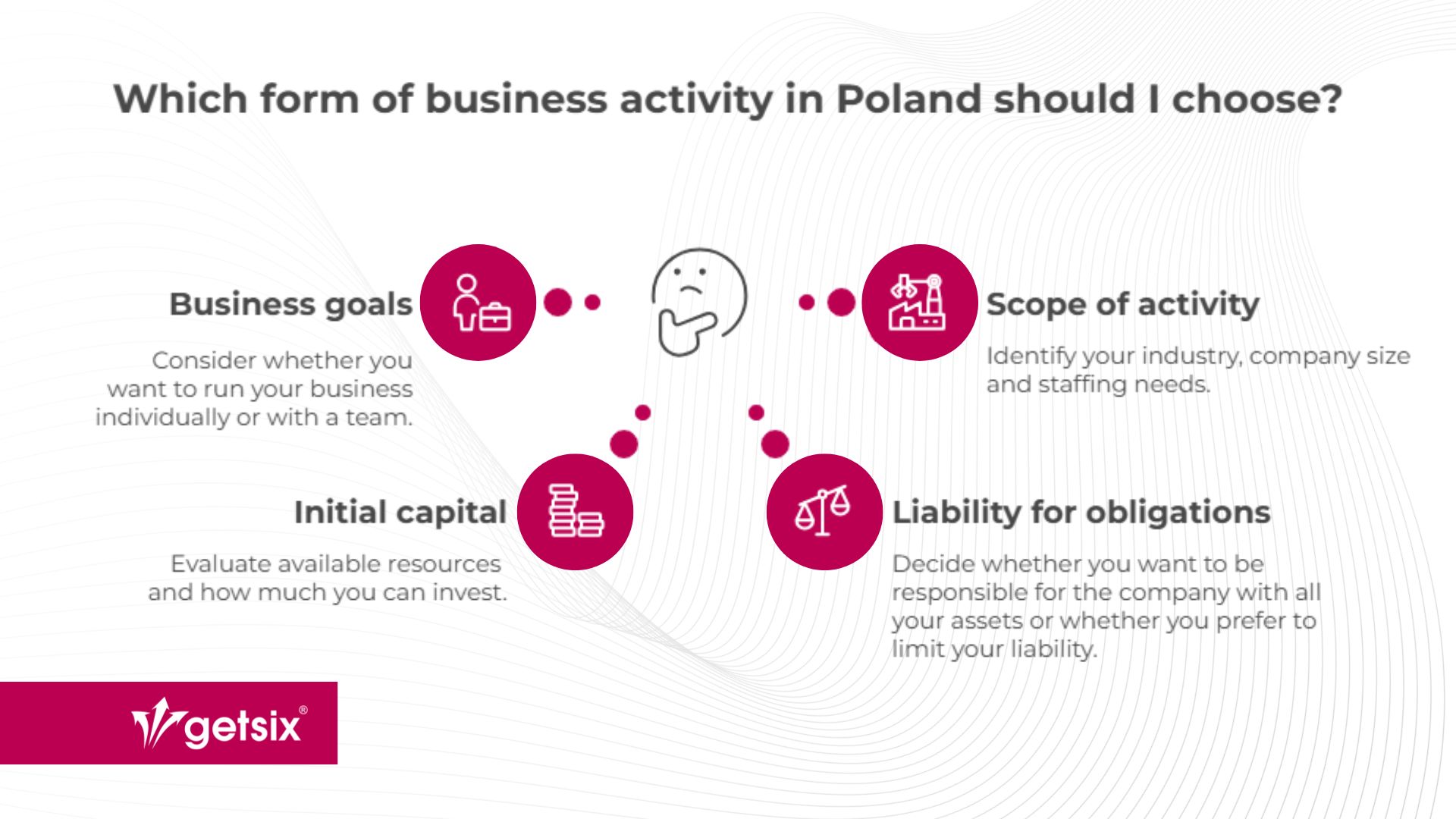
Before you register a company in Poland, it is worth assessing several practical issues:
If accounting obligations are part of your decision-making process, it is also worth considering whether the chosen structure will require full accounting in Poland or whether a simpler bookkeeping model may be available at the outset.
A sole proprietorship is the simplest way to start a business in Poland. It is registered in CEIDG and the entrepreneur acts in their own name. This is a common option for consultants, self-employed professionals and small service providers.
Who is it recommended for?
Advantages:
Limitations:
A civil partnership is not a separate legal entity in the same sense as a commercial company. It is based on an agreement between partners, while the partners themselves remain the entrepreneurs. This distinction is important from both a legal and practical perspective.
Who is it recommended for?
Advantages:
Limitations:
A general partnership is one of the basic partnership forms under Polish commercial law. It conducts business under its own business name and can acquire rights and incur obligations in its own name. For many founders, it is a more structured alternative to a civil partnership, but it still does not offer the liability shield associated with a limited liability company.
Who is it recommended for?
Advantages:
Limitations:
A professional partnership is designed for individuals performing specific regulated professions. One of its key features is that, as a rule, a partner is not liable for the consequences of professional services provided by other partners or by persons subordinated to them.
Who is it recommended for?
Advantages:
Limitations:
A limited partnership is useful where the founders want to differentiate roles and liability levels. It includes at least one general partner and at least one limited partner.
Who is it recommended for?
Advantages:
Limitations:
The limited liability company remains one of the most frequently chosen forms for foreign investors and growing businesses in Poland. It is often the natural choice where separation between private assets and business risk is important.
Who is it recommended for?
Advantages:
Limitations:
If you are considering this structure, you may also want to read: Register company in Poland – Limited liability company (LLC).
The simple joint-stock company is a relatively modern form that remains highly relevant in 2026, especially for innovative businesses and founder-investor structures. It combines selected features of capital companies with greater organisational flexibility than a traditional joint-stock company.
Who is it recommended for?
Advantages:
Limitations:
A joint-stock company is designed mainly for larger ventures requiring a formal corporate structure and broader capital-raising possibilities. For most entrepreneurs starting out in Poland, it is a specialist rather than a default option.
Who is it recommended for?
Advantages:
Limitations:
A limited joint-stock partnership is typically used in more advanced ownership structures. It combines elements of a partnership and a joint-stock company, but it requires a much higher degree of legal and tax awareness than the more common options.
Who is it recommended for?
Advantages:
Limitations:
In practice, most entrepreneurs who want to register a company in Poland compare three main options first: a sole proprietorship, a limited liability company and a simple joint-stock company.
For this reason, these three forms are often the most realistic starting point in 2026. Other structures are usually chosen when they reflect a specific professional, ownership or tax need.
At an early stage, some entrepreneurs also look at non-registered activity. However, this is not the same as formally registering a business in Poland. It may be useful for testing a very small-scale concept, but it is not a substitute for a proper business structure where the activity is intended to be ongoing, scalable or professionally organised.
If you plan to work with B2B clients, hire staff, build a recognisable brand, enter contracts on a regular basis or expand in Poland, formal company registration remains the proper route.
The right legal form should be chosen based on your business model, level of risk and growth plans, not only on how easy the registration looks at the start. For some entrepreneurs, the simplicity of a sole proprietorship will be enough. For others, the stronger liability protection of an LLC or the flexibility of a simple joint-stock company (PSA) will be far more appropriate.
If you plan to register a company in Poland for a business that is expected to grow, cooperate with investors, expand internationally or operate within a clear ownership structure, the legal form should ideally be selected after reviewing the tax, accounting and organisational consequences in advance.
If you need support with company registration in Poland, choosing the right legal structure or organising accounting support in Poland, getsix® can help you prepare a solution aligned with the scale and profile of your business. Contact us.
If you have any further questions or require additional information, please contact your business relationship person or use the enquiry form on the HLB Poland website.
***


Download the brochures providing general information and outlining the services that are offered by HLB member firms.
Learn more
Click below for more detailed information regarding population, major towns and cities, language, religion and holidays in Poland.
Learn more